
The Battle Against Ardisia Crenata
An invasive plant which has been afflicting the Florida Panhandle for years continues its reign despite ongoing efforts.
In the weeds of Florida’s capital, between highways and concrete, there is a silent conquest happening within the greenery. What at first glance may appear to be a peaceful grove, is in truth under attack by a silent assailant.
Ardisia Crenata, known locally in Tallahassee as Coral Ardisia, is an invasive plant that has been plaguing the Florida Panhandle and the larger southeast United States for years, as it overpowers native plants and is toxic to livestock. Known as Christmas Berry, or coral berry, or even spiceberry, Ardisia Crenata is easily identified by its bright red berries which grow in bunches, its white petals which may be a light pink, and its dark waxy leaves that are scalloped around the edges. It is those berries that make it so damaging to local natural areas, as they have a high germination rate of up to 98% depending on the soil, according to the Florida Department of Agriculture and Consumer Services.
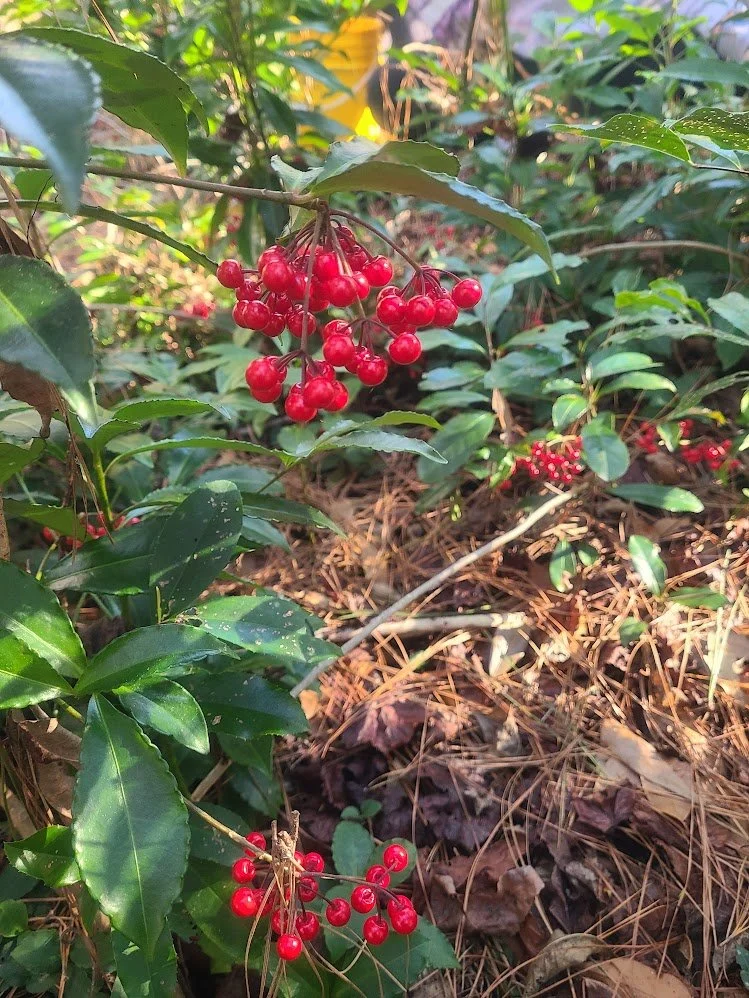
Ardisia Crenata weighed down by the heft of its vibrant berries. (Credit: Lavinia Williams)
Once a berry touches the forest floor – whether it falls itself or a bird eats one and spreads the seeds – the chance that a seedling sprouts is nearly a guarantee. Ardisia Crenata seeds can even survive years after being distributed until suitable conditions arise for them to sprout. They grow in colonies, with whole swathes of forest being covered by Ardisia Crenata, overshadowing native understory plants. Essential ecological diversity is engulfed beneath.
How did Aridisa Crenata find its way into Tallahassee?
Ardisia Crenata first came to Florida from its native region of Japan and northern India in the late 1800’s. The primary purpose of its use was simply ornamental. People would plant Aridisia Crenata in their yards to display the vivid alluring berries, which were the very things causing its spread. It was only determined to be an invasive plant in 1994, and the state of Florida decided it to be a noxious weed in 2014, as recorded by First Coast Invasive Working Group. By that point, it was much too late.
Lore Nix, with a bachelor's degree in biology and a focus on conservation botany, describes what Ardisia crenata enjoys so much about Tallahassee.
“Coral ardisia (Ardisia crenata), like many invasive plants, thrives in areas like Tallahassee because of the abundance of resources (water, sunlight, nutritious soil), and the lack of natural predators,” Nix said. “The moist hammocks, or wet hardwood forests, that characterize Tallahassee's local environment almost perfectly resemble the plants’ original growing conditions. Coupled with the abundance of hungry songbirds and small mammals attracted to the bright red berries, Coral Ardisia berries can quickly travel across the city in the bellies of local animals.”
Local environmental organizations in the Panhandle do what they can to assist the community -- Florida State University’s Environmental Service Program being one of them. Once Ardisia Crenata takes root in the ground and establishes a thick assemblage, the first solution is to physically remove the plant by force. During the 2026 spring semester, the FSU Environmental Service Program took part in four invasive removals focusing on Ardisia Crenata.
“During our removals, we often have one group of people removing berries and collecting them in bags before another group moves in to actually extract the plants,” said Carolina Espejo, a masters student in Environmental Science and longtime member of the Environmental Service Program. This way, they prevent the additional harm that could be caused if berries were spread into the surrounding soil.
“The second step is making sure we remove the entire root system. Weed wrenches come in very handy for this as the plants can resprout if the entire root system is not taken out properly,” she said.
“Once removed, the berries have to be bagged and disposed of securely while the plants themselves can either be burned or composted.”
The final step kills the plant where it begins: destroying the berries so that they are unable to find themselves in a patch of soil and later sprout. While the process seems antiquated and time consuming, this is the best way to remove such an aggressive invasive without aiding in its proliferation.
The resilience of this plant, which helped it to survive in its natural habitat, makes it a powerhouse in the Southeast U.S. ecosystem.
Ardisia Crenata is a problem that started with human introduction, and can end with human intervention. If looking for a plant to grow in the yard that sports bright red berries, it’s much better ecologically to plant a Florida native- like a Firebush, or an American Holly. The things that we do in our yard do not occur in isolation; vegetation spreads throughout a city faster than one may think, and takes hold before we may notice.
This story was initially edited by Yacob Reyes.