
Beyond Thrifting: City Walk Keeps Textile Waste Out of Landfills
Tallahassee’s City Walk Urban Mission expands the typical environmental benefits of thrifting through their recycling processes.
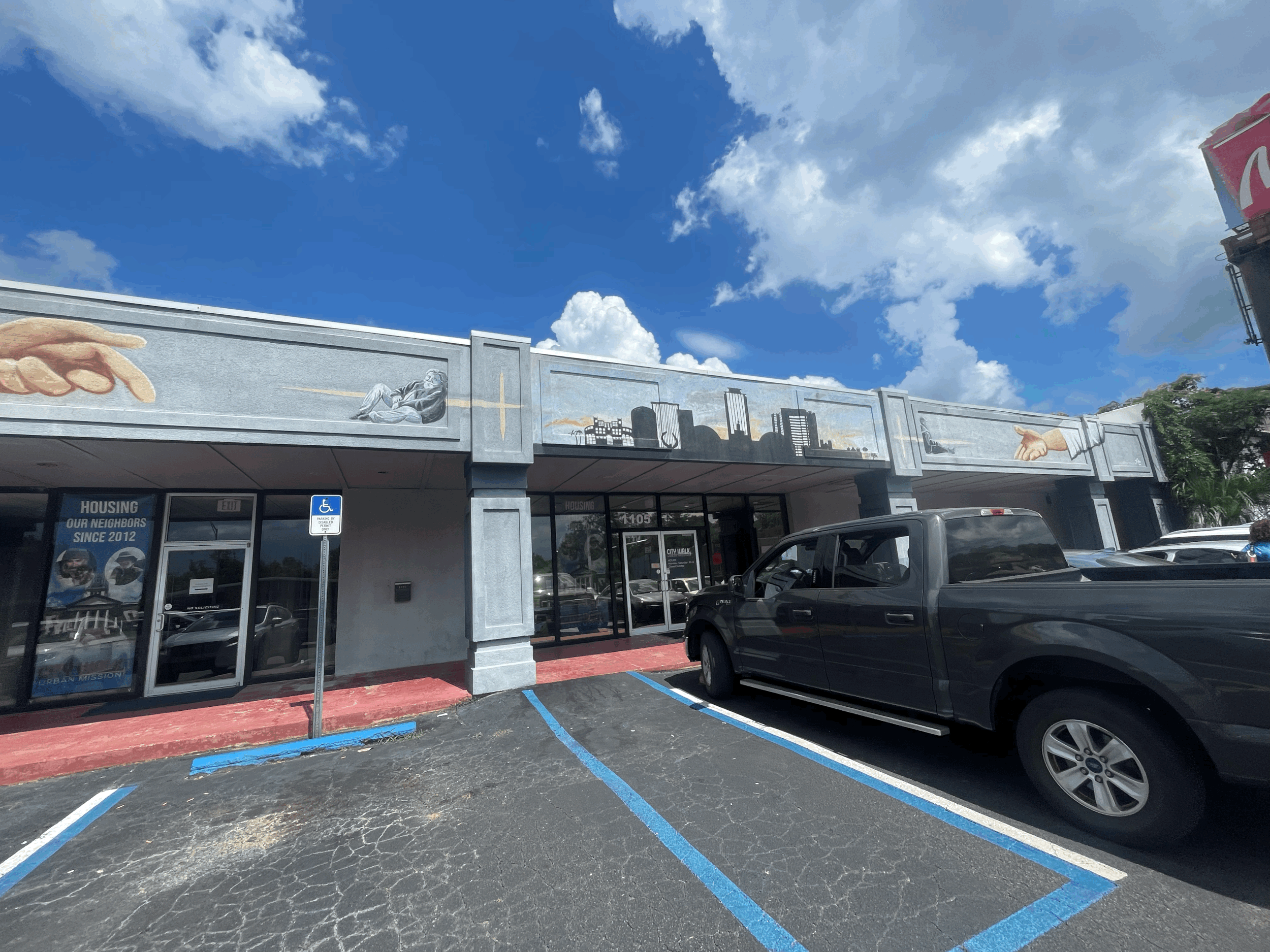
Tallahassee’s City Walk Urban Mission expands the typical environmental benefits of thrifting through their recycling processes. Photo: Raquelle Elson
The popularity of thrifting has increased over the past few years as shoppers consider the impacts of shopping on the environment as well as on their wallets. While thrifting is an easy way for shoppers to be more environmentally friendly, stores are beginning to follow suit.
One such store is City Walk Urban Mission.
Positioned on Tallahassee’s Monroe Street, surrounded by restaurants and vintage stores, the establishment is easily identifiable by its grayish blue coloring and mural of the city skyline.
Upon entering the store, customers are greeted not only by friendly employees, but also an array of jewelry, trinkets, and delicate adornments for one’s dining room. In a secluded room to the back right, shoppers shuffle past one another to investigate the store’s collection of DVDs, board games, and books.
The central part of the store displays its selection of men’s and women’s clothing, shoes displayed atop the clothing racks. Behind the clothes is a showroom full of furniture, household appliances, and electronics.
While the store does not showcase a wide variety of toys, co-owner Tony Miller makes sure to include them in the store’s monthly fill-a-bag sale.
Across Florida, the average person generated 85.9 lb of post-consumer textile waste, or textile waste, each year and recycled 5.7 lb of that waste each year. In places like Leon County, where there is a high number of college graduates, individuals generate over 80 pounds of fabric waste each year.
College student Nani Rutherford is an avid thrifter as a way to save money.
“I do thrift pretty regularly. I often go to the Goodwill bins, Citywalk Urban Thrift, just anywhere that's really affordable,” Rutherford said. “I find that even though the curated vintage stores have nice stuff, it's really like you got this for $2 at the thrift store, and now you're selling it for $40.”
Thrifting has become a common solution to this issue. The resale market is expected to more than double by 2028, growing 6.4 times faster than the broader retail clothing sectors.
In an effort led by Miller, City Walk assumes the responsibility of reducing waste by collaborating with other businesses in an effort to properly recycle the items the store deems unsellable.
The back of the building is home to the store’s sorting and recycling systems. Employees separate sellable donated items from what is trash. The trash is then sorted based on its material for recycling.
A large yellow bin contains all of the store’s recycled metal.
“Every Tuesday, a scrapper comes and gets all this scrap,” Miller said. “Because it's not worth my time, but I don't want to put it in a landfill; I want to recycle it.”
A semi truck contains plastic bags filled with unwanted clothes. Sarasota-based recycling plant Suncoast Textile provides and replaces semi trunks for City Walk so that the discarded clothing can be properly disposed of.
Whether it be an effort to be environmentally friendly or simply a way to save money, thrifting has become a part of the state’s shopping habits.
“I step in where I can, even though it is small scale,” Rutherford said. “But if you think, ‘oh well, I'll just continue to do my $300 fast fashion hauls because it's not hurting anybody now.’ If everybody thinks like that it defies the whole purpose of coming together to save the environment.
Stores like City Walk Urban Mission helps to share the responsibility and promote environmentally conscious thinking throughout the community.
This story was initially edited by News Watch mentor Srishti Prabha.
-
SRISHTI PRABHA: Thrifting is trendy.
Nationally, research finds that thrift sales are expected to double by 2033.
And while usually the idea of thrifting appeals to the customer as a way to get cheaper items and potentially be environmentally friendly
One thrift store in Tallahassee takes on the responsibility of reducing waste.
Florida Student News Watch reporter Raquelle Elson takes us there.
RAQUELLE ELSON: On a sunny Saturday afternoon, cars cruise by the restaurants and vintage stores lining Monroe Street, a busy corner of Tallahassee.
One building stands out: its grayish walls painted with a black mural of downtown Tallahassee.
This is City Walk Urban Mission. It’s a thrift store that houses clothes
[Sounds of people sifting through clothes]
RAQUELLE ELSON: As well as appliances and electronics… anything you could need
[Sounds of appliance]
RAQUELLE ELSON: Naji Rutherford is not only a shopper. She also volunteers here in her limited free time.
NAJI RUTHERFORD: As a college student, it is important to me to save money and be able to express myself through my clothes, but also have enough money for gas, rent, and stuff like that. But also, I am a huge environmental person. I think there's not enough being done to protect the environment.
RAQUELLE ELSON: Researchers have found that fabric waste in Florida is an issue tied to education.
In areas with a higher number of college graduates, fabric waste increased.
And in Leon County, where City Walk is located, there are three colleges in the area
Here, individuals produce over 80 pounds of fabric waste each year.
Thrift stores like City Walk take their environmental efforts a step further.
[SOUNDS OF RECYCLING]
RAQUELLE ELSON: Employees sort through all of the donated items to separate what is sellable from what is trash.
From there, the items are scrapped based on their material.
[SOUNDS OF RECYCLING]
RAQUELLE ELSON: Behind the building, scrap metal, which the thrift store obtains as toasters and baking trays is collected in a gigantic yellow bin.
Once the container is filled, scrappers collect the metal for recycling.
Co-Owner of the store Tony Miller heads the store’s recycling and disposal processes.
TONY MILLER: Every Tuesday, a scrapper comes and gets all this scrap. I don't want to put it in the landfill.
RAQUELLE ELSON: Miller says the store has also partnered with Suncoast Textile Recycling to recycle fabric waste, which involves a large white semi-truck.
TONY MILLER: They pay us about 10 cents a pound. We'll get a check. Every time we fill one of these, it takes about six weeks.
RAQUELLE ELSON: Businesses like this store allow customers like college student Naji Rutherford to fulfill their thrifting goals.
NAJI RUTHERFOD: So definitely I step in where I can, even though it is small-scale, but if you think, like, oh, well, I'll just continue to do my $300 fast fashion hauls because it's not hurting anybody now. If everybody thinks like that it defies the whole purpose of coming together to save the environment.
RAQUELLE ELSON: Rutherford says decreasing individual waste is the whole point of thrifting.
For her, it takes everyone, from the merchant to the customer, to make an impact on the environment.
Raquelle Elson, Florida Student News Watch.