
March of the Mangroves
PART 2 → March of the Mangroves
What happens if mangroves replace salt marsh?
The Big Bend Region contains the largest expanse of salt marsh in Florida. New mangroves disrupt the salt marsh equilibrium, threatening existing biodiversity and casting salt marsh grasses into the shade.
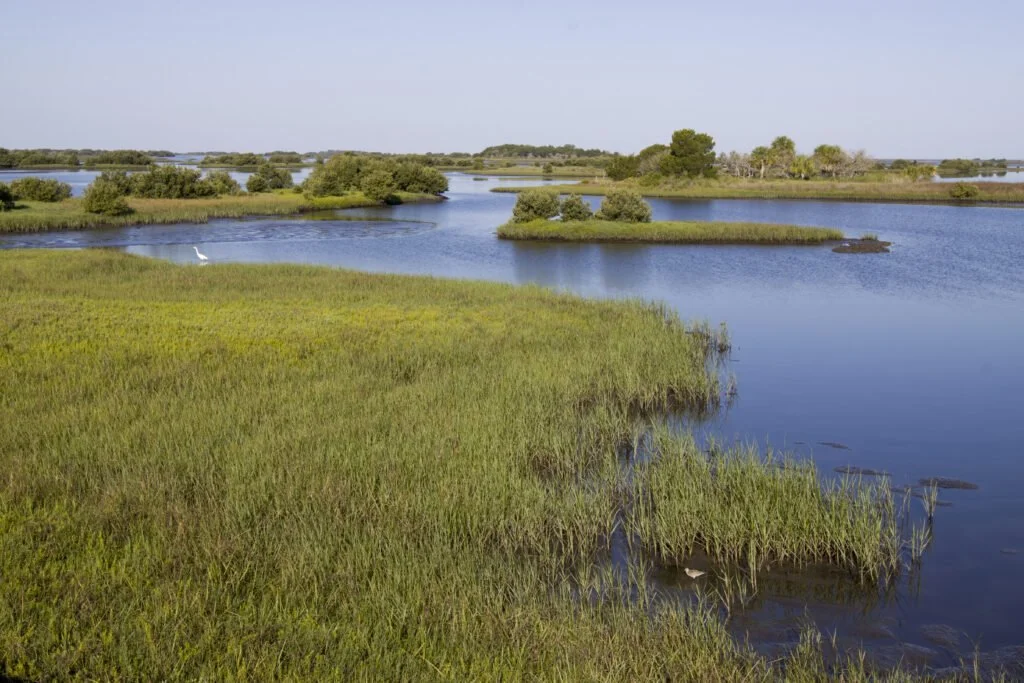
Coastal wetlands in Cedar Key, Florida. Credit: Tyler Jones (UF/IFAS).
“Mangroves moving in are going to provide new habitat, but it's going to change, because there are different types of animals that utilize marsh that are not going to find mangrove to be so appealing,” Florida State University’s Josh Breithaupt said.
Salt marshes also serve as nurseries for crabs and fish, while species such as the endangered Florida salt marsh vole hide within Cedar Key’s tall grasses. A rodent which can reach about seven inches long, the vole is a sensitive creature with limited range, especially vulnerable to changing climates and habitat loss, according to Florida’s wildlife agency.
The vole eats marsh plants such as cordgrass and bulrush, while in turn, sustaining predators such as hawks, minks, and snakes. When mangroves replace marsh, rodents can be left hungry, exposed, and vulnerable.
Ironically, salt marshes protect the very species which puts them under threat. The marsh shelters baby mangroves from cold temperatures, allowing them to eventually outgrow and drive out salt marsh grasses. Breithaupt predicts that, in 50 years, mangroves will dominate the bayside of islands south of the Big Bend, such as St. George’s.
Briethaupt showed a map of Apalachicola Bay and gestured toward all of the barrier islands in the area, many of which house marsh-mangrove transition areas and burgeoning black and red mangrove populations.
“They're not going anywhere. Another 25 to 50 years from now, this is covered in mangroves. There's no way that this is not entirely all mangrove,” Briethaupt said.
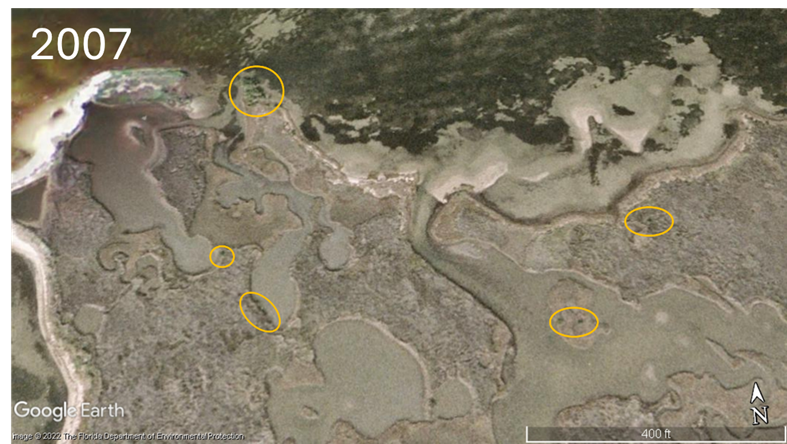
Yellow circles denote sparse mangrove presence in the Apalachicola Bay in 2007. Photo provided by Josh Briethaupt.
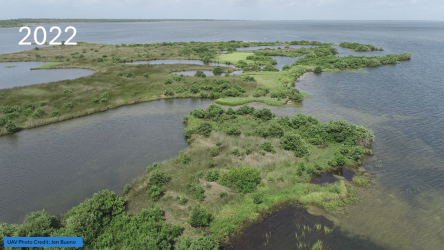
Fifteen years later, mangroves are abundant in the same area.
Photo provided by Josh Briethaupt/credit Jon Bueno.
Mangroves surviving the heat
“South Florida is tropical, that’s true, but not the most tropical place in the world. So [mangroves] still have a lot of potential to maximize their growth there,” University of Florida graduate Yiyang “Calvin” Kang said. “In tropical Southeast Asia, similar species can even grow to [100 feet].”
Kang said warming temperatures do not pose a threat to the trees in southern Florida; rather, mangroves below Cedar Key largely contend with a lack of nutrition and rising sea levels.
In the Everglades, where mangroves dominate over marsh, the trees can grow up to 70 feet tall. A short drive away, mangroves in the Keys struggle to grow taller than three feet due to insufficient nutrients in their water.
In South Florida, rising sea levels push mangroves inland and restrict their range of growth. In the Big Bend, warming temperatures expand their range, allowing mangroves free reign along the Gulf Coast and further inland.
Wayward trees affect North Florida residents
Left to their own devices, mangroves have begun to grow to new heights on Big Bend residential properties, inhibiting coastal homeowner’s ocean views.
The Florida legislature reflects a statewide desire to protect mangroves. The Mangrove Trimming and Preservation Act has stood since 1996, making it illegal to remove, destroy, or damage mangroves. Homeowners concerned about mangrove growth can employ professional trimmers to properly maintain the trees in their backyard.
But for Floridians who have never had to consider mangroves before, protecting the tree along the Gulf coast may require new legislation. For example, can residents remove a propagule from their property if it has not taken root? The law may need updating or better enforcement in the Big Bend to properly accommodate mangrove migration.
A new Florida Senate bill called “Coastal Resiliency" (SB302) will expand wetland restoration and mandate natural solutions for strengthening coastlines. This bill went into effect on July 1, directing attention to mangroves, especially for the Big Bend coastlines who have historically relied on the reinforcement of salt marshes, but which soon may be fortified by mangroves.
“We know that both marshes and mangroves are good at suppressing the wave heights, but we know that mangroves are better,” Breithaupt said.
“So you could argue for a homeowner, that down the road it probably is better to have mangroves there because if you get a direct hit hurricane with a big storm surge, the mangroves are probably going to do a better job suppressing that,” he said.
Fisherpeople also keep a close eye on the new mangroves, which bring with them new fish species. Tropicalisation includes northward-bound fish such as snook.
Anglers are more likely to embrace new fish than the salt marsh wildlife who find mangroves less accommodating.
Judging the effects
The consensus among researchers is precisely that there is no consensus: Is mangrove tropicalisation a positive or negative phenomenon? It is unclear.
The research of both Kang and Breithaupt seeks to observe and measure how tropicalisation affects mangrove species, rather than assign a value judgement to their migration.
The march of the mangroves is merely a symptom of climate change. The forecasted domination of mangrove over marsh shows how warming temperatures can cause ecosystem transitions. North Floridians can expect to watch their salt marshes give way to mangrove jungle in the Apalachicola Bay region and beyond in the years to come.
“It’s really hard to decide if the impact is positive or negative. We as researchers are just basically documenting what we’re seeing,” Kang said. “There are benefits and drawbacks depending on which species you are trying to protect.”
This story was originally edited by News Watch mentor Max Chesnes.