
March of the Mangroves
PART 1 → March of the Mangroves
What a species of plant teaches us about climate change.
Deep in the flowy salt marshes off Little St. George Island in the Apalachicola Bay, a new species is sneakily taking root, far away from home. Here, the mangrove tree is busy building an outpost, nestling thousands of its seedlings under the marsh’s grassy canopy.
During chilly North Florida days, these little ones will be sheltered and kept several degrees warmer within the marsh. In five to seven years, scientists estimate, they could tower over the grasses, and the once-expansive salt marsh may become mangrove jungle.
As the planet warms, mangroves have been spotted moving into northwestern Florida, encroaching on salt marsh territory. Where cordgrass and needle rush once dotted the landscape, mangroves are quietly taking their place.
Experts are still piecing together the implications.
For one: Mangroves are a marvel of nature. They’re a group of tropical and subtropical trees that grow in salty water along Florida’s coastlines. Their roots help to anchor shorelines, buffer against rough tides, filter carbon dioxide from the atmosphere, and protect coastal communities – both human and animal – from tropical storms.
But there are animals that depend on the native salt marshes, too. Salt marshes are coastal wetlands, expanses of green grass flooded and drained by the tides.
What comes of the white shrimp and ribbed mussels, that rely on wavy grasses, when a new and towering tree arrives? For mangrove experts across the state, the questions remain.
“When mangroves start to come in, they get taller, they get woodier, and you’re putting up a forest where there used to be a marsh,” said Josh Breithaupt, an Assistant Research Faculty member at the Florida State University Coastal & Marine Laboratory. “The most frequent question I hear when I’m talking to people about mangroves moving in is: Well, is that a good thing or a bad thing?”
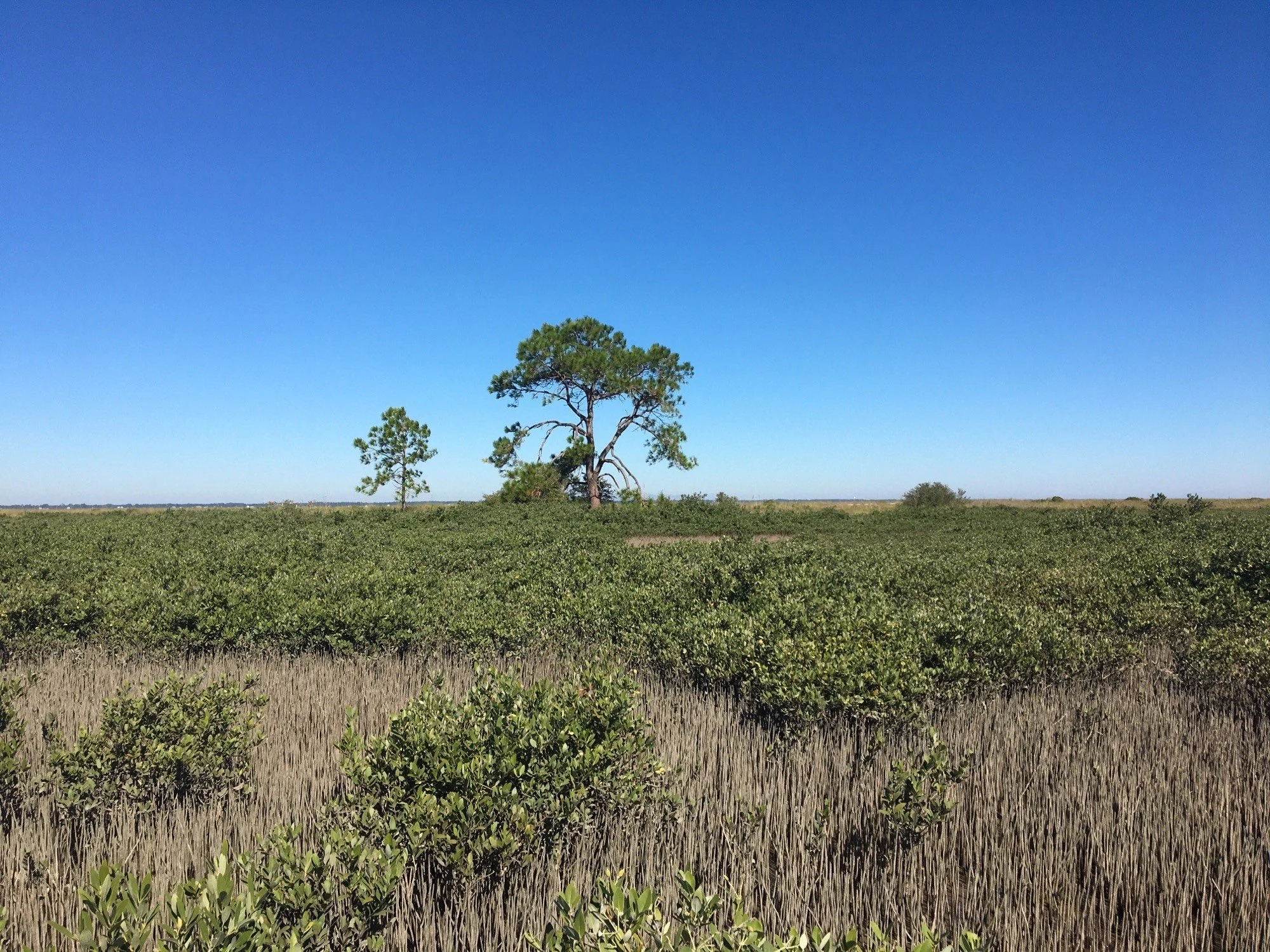
Black mangroves grow within the marshes of the Apalachicola Bay. Photo provided by Josh Briethaupt.
A venerable Florida species
Mangroves, unlike humans, can bathe in salt water all day without shrivelling up like raisins. They are one of the only trees that can grow directly in saltwater, through their complex filtration systems and above-water roots.
Mangrove forests are also an example of what are called blue carbon ecosystems. They absorb carbon dioxide from the atmosphere and tuck it away in their roots, branches, and sediments, which helps offset effects of rising CO2 levels in our changing global climate.
Yiyang “Calvin” Kang was recently awarded a Ph.D. from the University of Florida School of Natural Resources and Environment for studying how mangrove ranges are expanding.
“The minimum air temperature is lifted and that’s letting them settle down without being killed over the winters,” Kang said.
South of St. Augustine and Cedar Key, Florida is home to three of Earth’s more than 80 mangrove species: the black, red, and white.
Black mangroves have spindly, finger-like roots that peek above the soil, like straws through which they slurp carbon dioxide, and they excrete salt through their leaves. Red mangroves hover above the water, like a neighborhood of houses on stilts. White mangroves thrive in the highest salinity and grow twice as fast as red mangroves, hunkering down in the soil quickly with their complex root system. In Florida, tropicalisation – when tropical species ranges expand poleward – plays out in real time as mangroves take on Apalachicola Bay by the Gulf Coast and march past St. Augustine on the Atlantic Coast.
Before 2010, it was almost unheard of for mangroves to creep northward. If a mangrove seed, called a propagule, was swept away by a current, the young tree would quickly perish in cold temperatures. With fewer freezing events to stunt their growth in the last decade, mangroves have seized their opportunity to make warming regions home.
Breithaupt’s lab, a watchtower for mangrove expansion, is located on the Gulf of Mexico near the Apalachicola Bay System. Florida’s Big Bend, also known as the state’s “Nature Coast,” is a 250-mile stretch of coastline where the Florida Panhandle transitions to the Florida Peninsula.
Apalachicola Bay is separated from the Gulf of Mexico by a chain of barrier islands. Two of the four main barrier islands, St. George and Little St. George, have burgeoning mangrove populations in their backyards.
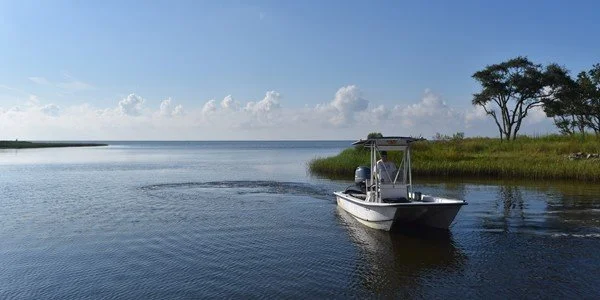
Gulf of Mexico out by the FSU Coastal & Marine Lab.
Credit: FSU Coastal & Marine Lab.
Breithaupt explained that the Bay water serves as a buffering environment around the island. Even during cold snaps, the barrier islands trend several degrees warmer than the mainland, which is ideal for the mangrove accustomed to tropical temperatures.
“They'll have freeze damage, you can go out and look at the leaves, they'll be burned, but ultimately, enough of the individuals survive to keep going,” Breithaupt said.
This story was originally edited by News Watch mentor Max Chesnes.